
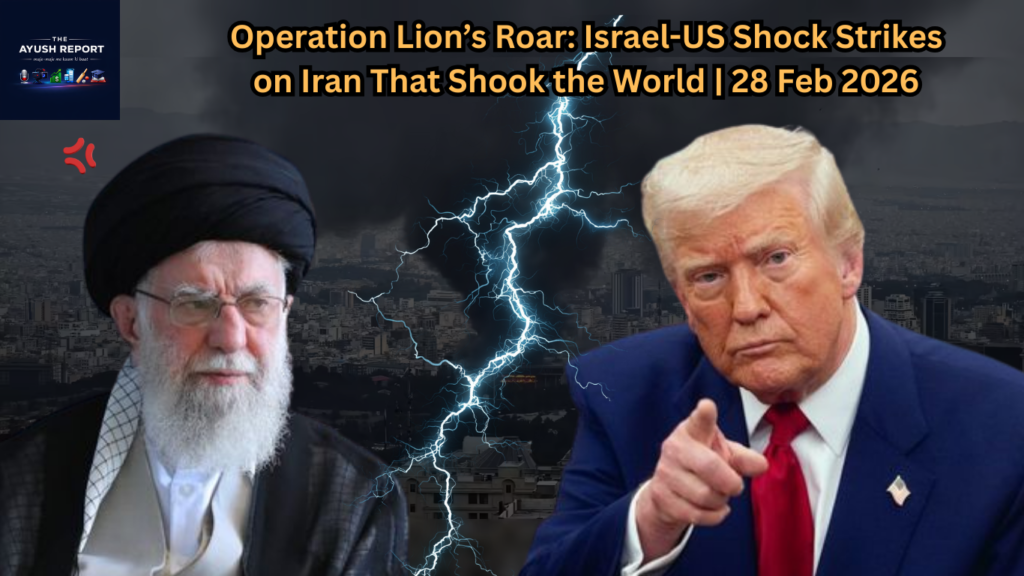
Israel-US Shock Strikes on Iran

Big and shocking news came out of the Middle East early on February 28, 2026. Together, Israel and the US conducted synchronised military attacks on Iran, resulting in devastating explosions in Tehran, the Iranian capital, as well as a number of other key cities. Images and videos of columns of smoke billowing above Tehran’s skyline rapidly went viral on social media.
The operation was referred to as a “pre-emptive strike” by Israel’s Defence Ministry, which is an attack intended to eliminate a significant and imminent threat before it materialises. Credible information inputs suggesting parts of Iran’s missile and military capabilities constituted a “imminent threat” to Israel, according to Israeli authorities.
However, U.S. officials also affirmed that the United States supported the operation militarily and strategically. Tehran condemned it as an outright assault on its sovereignty, while Washington called it an essential move for regional security.
Israel-US Shock Strikes on Iran : Thus, a high-intensity battle that many experts view as a watershed in the Middle East’s power dynamics began on February 28.
Even the official complex of Supreme Leader Ayatollah Ali Khamenei reported hearing explosions, according to certain media sites. This accusation made the situation even more delicate, even if it was challenging to independently verify these reports right away. The operation may have been part of deeply strategic messaging rather than just symbolic if leadership-level locations were on the target’s radar.
Overall, it was evident that this was a multi-city, coordinated military operation with a seemingly significant scope and impact rather than a single hit.
Location: Tehran as well as several other Iranian cities
Israel-US Shock Strikes on Iran
The first strong explosions were said to have occurred in the Iranian capital, central Tehran. Witnesses saw many explosions close to University Street and the Jomhouri neighbourhood, which were followed by thick smoke plumes. News of explosions in these two places instantly triggered a nationwide alarm since they are regarded as busy and strategically significant parts of Tehran.
Reports also showed that the attacks had spread to several Iranian cities in a coordinated manner, not simply Tehran. In cities like Qom, Isfahan, and Kermanshah, reports of missile impacts and airstrikes have surfaced. One of the main topics of discussion among analysts was the strategic significance of these cities, especially for military sites and facilities connected to nuclear.
According to certain media sources, the explosions could be heard all the way to the official facilities of Supreme Leader Ayatollah Ali Khamenei. The accusation made the situation even more delicate, even though it was challenging to independently confirm these reports right away. It could indicate that the operation was not only symbolic but rather a component of highly strategic messaging if the target was aware of leadership-level regions.
Overall, (Israel-US Shock Strikes on Iran) it was evident that this was a multi-city, coordinated military operation with a seemingly significant scope and impact rather than a single hit.
ISIS Operation Timeline (Chronological Breakdown) 🐉 Weeks Prior to the Attack

Israel-US Shock Strikes on Iran
ISIS’s military buildup had long been planned. Nuclear talks between the US and Iran were taking place in diplomatic hotspots like Vienna and Geneva weeks prior to the attack. The US-led sanctions release and Iran’s uranium enrichment program were the primary topics of discussion. While the US and other Western nations demanded enrichment limits and stringent inspections, Iran refused to place additional restrictions on its nuclear program until economic sanctions were withdrawn.
Rapid escalation of regional military movements coincided with negotiations reaching a standstill. The United States reportedly moved its fighter fighters, aircraft carriers, and navy vessels throughout the Middle East. Analysts characterised the noticeable increase in US military activity in the Gulf region as a “pressure strategy.” This build-up served as a warning that military alternatives are available in the event that diplomacy failed.
28 February — Early in the morning
Israel-US Shock Strikes on Iran
The situation abruptly turned explosive early on February 28. There were loud booms in several locations of Tehran when Israel launched missiles against Iran. Emergency sirens and smoke plumes were visible in the first images. Multiple impact points were reported at the same time, suggesting that the strikes were well-coordinated.
Israel immediately issued national alerts and briefly closed its civilian skies following the attack. People were urged to remain in shelters as civil defence systems were triggered. This suggested that Israel was ready to strike back as well.
Iran, on the other hand, disrupted foreign planes by promptly closing its airspace. According to certain accounts, limitations were also placed on internet connectivity and mobile networks in order to manage information flow and guarantee efficient security operations.
👉 US Confirmation Same Day
Israel-US Shock Strikes on Iran
Within a few hours, official confirmation came from Washington. The United States actively participated in the operation, according to open statements by US officials. Its designation as a “major combat operation” suggested that it was a carefully thought-out military conflict rather than just a small-scale attack (Israel-US Shock Strikes on Iran).
Israel gave their operations strategic and symbolic names, including “Lion’s Roar” and “Shield of Judah.” The usage of these code names raises the possibility that the measure is a component of a longer-term security doctrine rather than a temporary fix. Code names are frequently employed for public messaging and military morale, and in this case as well, the narrative that the strike was defensive and preemptive was developed.
👉 After hours
Israel-US Shock Strikes on Iran
Reports grew clearer in the hours that followed the incident. The strikes targeted Iranian military camps, missile storage facilities, suspected nuclear-related locations, and high-value leadership infrastructure, according to a number of intelligence sources and media outlets.
Joint coordination showed that, following careful planning, the US and Israel acted in unison. According to analysts, the goal was to either temporarily or permanently weaken Iran’s strategic capabilities in addition to causing tactical harm.
It is evident from the period as a whole that this was not a snap choice. The early morning strikes on February 28 were the result of weeks of diplomatic strain, military buildup, and intelligence evaluations.
The Attack’s Main Objectives and Plan

Israel-US Shock Strikes on Iran
Military experts claim that this attack was a well-planned, intelligence-driven operation rather than a haphazard bombing. The choice of targets makes it evident that the goal was to undermine Iran’s strategic foundation rather than just cause symbolic harm.
🧨 Target Identification
Israel-US Shock Strikes on Iran
According to the most sensitive sources, the explosions could be heard all the way to Ayatollah Ali Khamenei’s official facilities in Iran. Having leadership-linked zones on radar is regarded as a powerful political and psychological statement, even though evidence of a direct hit was not immediately available.
The main targets were likewise determined to be Iranian ballistic missile sites and military installations. According to analysts, Iran’s ability to retaliate would be directly impacted if missile storage depots, air defence systems, or command-and-control centers were struck.
Additionally, reports indicated that Tehran was not the only target of the strikes. Multiple Iranian cities showed a pattern of synchronous hits, suggesting that the operation was coordinated and multi-location. Such coordinated attacks aim to mislead the adversary and take down several strategic nodes at once.
🪖 Method of Attack
Israel-US Shock Strikes on Iran
An official description of this operation was given by Israel as a “pre-emptive offensive.” This implies that a nation will conduct a preemptive strike to neutralise the danger when it receives reliable intelligence that an assault is about to occur.
The Israeli leadership maintained that its national security was immediately threatened by Iran’s nuclear development and ballistic missile capabilities. Thus, their goal was to prevent future strikes from happening. According to military doctrine, this is a high-risk, high-impact tactic that reduces the adversary’s operating capability while also sending a deterrent message.
US Participation
Israel-US Shock Strikes on Iran
Additionally, the United States publicly acknowledged its involvement in the operation. According to Washington, it is an important step in the larger framework for Middle East security. Advanced military equipment, monitoring assistance, and strategic coordination were reportedly all part of this engagement.
Even US President Donald Trump referred to the action as “major combat operations” to indicate that it was a significant military battle rather than just a symbolic or limited airstrike. This US position is viewed as a means of sending a clear message to Iran and reassuring friends in the region.
Overall, the tactics and target selection show that this operation was the outcome of a well-thought-out military plan with the goal of establishing strategic deterrence rather than a hasty response.
Background: What is the reason behind the significant increase in tension?

Israel-US Shock Strikes on Iran
The events of February 28th alone are insufficient to comprehend this entire war. Years of strategic rivalry, fruitless diplomacy, and regional power conflicts have led to this tension. Iran, Israel, and the United States had grown so distrustful of one another that a minor disagreement may turn into a massive conflict.
Iran’s Nuclear Program
Israel-US Shock Strikes on Iran
For many years, Iran’s nuclear program has been the subject of international discussion. Tehran has maintained that the goal of its nuclear program is to produce electricity for peaceful purposes. However, Western countries—especially the United States and European allies—have concerns that the level and speed of uranium enrichment could reach weapons capability in the future.
The closer uranium gets to military-grade capabilities, the higher the enrichment percentage. Thus, international inspections, transparency, and enrichment restrictions have continued to be key grounds of contention in discussions.
Iran’s main objective during the negotiations was to lift economic sanctions imposed on it by the United States and its allies, which had put significant strain on its economy. However, the West also desired restrictions on regional proxy power and missile development. The diplomatic process was frequently stalled—and the trust gap was widened—by the absence of agreement on these topics.
Israel’s Security Issues
Israel-US Shock Strikes on Iran
Iran’s ballistic missile and nuclear programs are seen by Israel as an existential danger. Israeli leaders think that the balance of power in the region may change significantly if Iran were to obtain sophisticated nuclear weapons.
Israel is also worried about Iran’s growing influence in the region through proxies and affiliated organisations, in addition to its direct military capabilities. Iran’s missile range and precision capabilities may directly attack Israeli territory, according to intelligence that Israeli officials have revealed on multiple occasions.
Because of this, Israel’s national security doctrine has always included the option of “pre-emptive action,” which is to strike first rather than wait until the threat seems imminent.
US Strategic Objectives
Israel-US Shock Strikes on Iran
Iran is not only a regional actor but also a key component of the larger Middle East security framework, according to the United States. The United States has sought to constrain Iran’s regional military growth and stop it from developing nuclear weapons.
At first, the US used economic sanctions and diplomatic talks to increase pressure. But Washington was presented with a policy conundrum as talks kept coming to a standstill and enrichment operations seemed to pick up speed.
Although the military option is officially regarded as a last resort, strategic calculations started to change when diplomacy failed to provide the desired outcomes. It is crucial to consider this context when evaluating the February 28 strikes, which were the result of protracted geopolitical tension rather than an abrupt response.
Instantaneous Worldwide Responses (Short Synopsis)

Israel-US Shock Strikes on Iran
Global diplomatic activity increased immediately following the Israel-US strikes.
🌏 World Leaders
Israel-US Shock Strikes on Iran
Urgent talks on the situation started on international forums, and several European nations started emergency consultations. There were calls for a U.N. Security Council emergency meeting to consider ways to stop the escalation and to establish a ceasefire.
📈 Oil Prices & Markets
Israel-US Shock Strikes on Iran
The financial markets also responded right away. Since the Middle East is a major center for global oil supplies, fears of growing war there caused crude oil prices to soar. Additionally, investors started moving toward safe-haven assets like gold, which caused gold prices to rise.
🧑🤝🧑 Actors in Regional Settings
Israel-US Shock Strikes on Iran
A number of South Asian and Middle Eastern nations, including China, Russia, India, Pakistan, and the GCC countries, voiced worry that intensifying the conflict will affect international trade routes as well as regional stability. These nations demanded moderation and a diplomatic resolution.
Is it possible for this war to spread? (Expert Evaluation)
Israel-US Shock Strikes on Iran
The most important question in light of the current circumstances is whether this will continue to be a local strike or if it could turn into a full-scale regional conflict. The possibility of escalation, according to experts, is very serious.
🔥 Indices of a Rise
Israel-US Shock Strikes on Iran
A concerted offensive by the US and Israel is the first factor. Open cooperation between two powerful military nations indicates that the conflict may intensify beyond temporary symbolic measures. Long-term readiness is typically indicated by such cooperative military planning.
Second, reaction has been indicated by Iran. Tehran has made firm declarations that it will retaliate for the assault on its sovereignty. The conflict’s reach might greatly expand if there are direct missile strikes or cyber reprisal.
Proxy fronts are the third and most delicate factor. Hezbollah, the Syria Front, and militias based in Iraq may become engaged in the area. The conflict could escalate into a multi-front war, which would pose a major threat to the peace of the Middle East, if these proxy wars break out.
Professional Views
Israel-US Shock Strikes on Iran
According to foreign policy observers, these actions were carried out when all other diplomatic avenues had been exhausted. According to some analysts, this move is intended to systematically impair Iran’s strategic capabilities rather than just serve as a warning or deterrence.
If “strategic neutralisation” is the goal, this may entail a longer-term pressure campaign rather than brief interactions. The severity of Iran’s response and the speed at which the international community may mediate will determine the course of events in the future.
The current state of affairs is extremely unstable, and even a minor military or political error could escalate the crisis.
Humanitarian Concerns & Impact on Citizens
Israel-US Shock Strikes on Iran
Panic swept over Tehran and a few other towns after the strikes. There were numerous reports of emergency sirens and structural damage. Thousands of travellers were impacted as foreign flights were cancelled or diverted due to airspace constraints. As civilian safety became the top priority, hospitals and emergency response teams were put on high alert.
Historical Background: When did hostilities start to worsen?
Israel-US Shock Strikes on Iran
Israel and Iran have always been rivals. In 2025, proxy wars and indirect battles also occurred. The February 28, 2026, strike, on the other hand, is unique since it explicitly acknowledged direct US involvement of this magnitude, elevating the conflict to a new level.
Important Lessons for Readers
Israel-US Shock Strikes on Iran
- Israel began coordinated attacks against Iran on February 28, 2026.
- The US affirmed that it was actively involved in the operation.
- Numerous cities, including those connected to the leadership, as well as Tehran were struck.
- Countering Iran’s nuclear and missile capabilities was cited as the main goal.
- The oil markets, international politics, and regional stability may all be significantly impacted by this development.
Final Thoughts
Israel-US Shock Strikes on Iran
The February 28, 2026, incident was more than just a lone or hasty military attack. It was the result of years of regional power struggles, mistrust, unsuccessful negotiations, and strategic rivalry. The already precarious balance in the Middle East has been made worse by the coordinated activity of the United States and Israel.
This operation’s effects will extend beyond the battlefield. In terms of geopolitics, this event has the potential to alter diplomatic equations, energy markets, and international alliances. It will have an economic impact on trade routes and energy costs. Civilian safety and regional stability have emerged as critical humanitarian issues.
How aggressively Iran responds and how soon the international community can implement successful measures will determine the future course of action. Given how unstable the situation is, every move that is made will be carefully considered.
There is no doubt that this event will be seen as a watershed in Middle Eastern history, as the distinction between military might and diplomacy once more seemed to haze.
For the latest updates on the Israel–Iran–U.S. conflict and every major development from the ground, stay connected with TheAyushReport.com — your trusted source for fast, reliable, and in-depth global coverage.